In June 2019, I was in Rome and Palestrina to explore streets named after Thomas Mann in light of the Mann memorial in Munich. Looking back, it was also interesting to see how natural it was to travel and move around in public space in contrast to the present day, 2020.
The road to Thomas Mann is quite long. The street named after him is on the outskirts of Rome. It takes one and a half hours on the 916 bus—including half an hour’s wait—all the other numbers pass by several times. When the bus finally arrives, it is full, with many commuters heading from the city center to the outskirts.
The street is in the northwestern district of Quartaccio on a ridge between flat valleys. The pejorative suffix “-accio” probably comes from the surrounding damp, marshy lowlands. Created in the 1980s as a hopeful and imaginative residential area—with postmodern references to the social housing of the 1920s and 1930s, gardens, arched passageways, and piazzas (used as parking lots)—it soon ran into problems, squatters, and drug dealing. Since the 2000s, the situation has improved with the construction of new apartment blocks and the influx of other demographic groups—but the area’s reputation still sticks, and it crops up often in police reports.
After disembarking, you walk over weathered concrete borders of dry green spaces. On Via Flaubert, you notice a group of concrete columns that form a square and are intended to evoke an archaeological park. Long rows of ochre-painted apartment blocks. People sitting on plastic chairs in front of their houses—reminiscent of Naples. At the edge of the house rows are fields, fallow land, reeds: the street becomes a dirt track, the city seems to be fraying; you can see down into a valley, in the distance there are more apartment blocks.
When I ask about Via Thomas Mann, two girls describe it as “In fondo, davanti alla chiesa” (at the end, in front of the church). There is indeed a street sign with this name under a tall streetlamp in front of a church dedicated to St. Faustina (think Doctor Faustus). It is quite modern with a wide overhanging metal roof on slender metal pillars. Only the cross on the roof and the hint of a temple-like roof identify it as a place of worship. It is connected to a sports center. The ASD Romana (sharks) basketball team trains here—an astonishing combination, but one that brings together two of the major social networks: church and sports.
Thomas Mann, however, was distanced from both. He was socialized as a Protestant but ironic in his approach to the religiosity of the church and its authorities (see the beginning of Buddenbrooks where Toni reads a chapter of the catechism). Astonishingly, he began Buddenbrooks in Italy (initially with his brother Heinrich) surrounded by Catholicism. The encounter is even more intense when you hear the church’s haunting Ave bells ring on every hour to the tune of the Lourdes melody. At 6:00 pm, a car pulls up in front of the church and nuns dressed in white get out. Time for mass. This is Rome. The contrasts could not be greater. The upper middle-class writer, here, in a—to put it mildly—structurally weak neighborhood. The “northern lights” of Lübeck and the cosmopolitan city to the south.
Yet, the coincidence goes beyond a street name that would only cover the canon of great European writers: Thomas Mann actually lived in Rome as a young man. Were the street name planners aware of this? Peter de Mendelssohn, who wrote the biography The Magician, mentions the addresses— Torre Argentina 34 and Via del Pantheon 57, 1897—in the chapter “Waiting in Rome.” Eight months after all! Mann himself also mentions his stay several times, including in his 1904 biography,but his former addresses are all in the heart of the old city, the centro storico, where tourists throng. In a place where everything is occupied by centuries-old buildings and names, it makes sense that the Romans did not name a street after the German writer there.
Here, on the periphery, however, there was space and the hope that the names might culturally enhance the construction project and give it a positive connotation as well as emphasize the unifying European culture. Thus, the great nineteenth-century writers from France and the northern countries are all concentrated here. The terminus is named after Andersen, there is a Via Fratelli Grimm, and Thomas Mann encounters, not inappropriately, Flaubert, Sand and Zola. He is thus associated with the 19th rather than the 20th century, a traditional context that he himself repeatedly emphasized.
It is noticeable that his “colleagues” are usually represented only by their last names. This makes sense in terms of the system of city maps, as it avoids the dilemma of whether to sort a street by a first name (as is generally the case in street directories) or a surname. Thomas Mann, however, is represented by both his first and last names. This demonstrates that there were more than just one writer named Mann, there were several, and that there is a need to designate individuals within the family by their first names. One certainly thinks of his brother Heinrich, who breaks with the restrictive use of the Mann name to only Thomas’ family.
Thomas was with Heinrich in Rome and for two summers in Palestrina, a small town about forty kilometers from Rome. There is a Via Thomas Mann there, too. And it is interesting to note that the brothers make a joint appearance there: Heinrich is also commemorated with a street name. That’s where we’re going next.
It takes about the same amount of time to get to Palestrina as it does to the Roman Quartaccio, only in the opposite direction to the east. It is an hour and a half by subway to the Anagnina stop, then by intercity bus through Rome’s countryside, which eventually merges into Campagna, with stops in small villages such as Zagarolo.
In Palestrina, Via Thomas Mann refers back to the Manns’ place of residence on this very street, making it the rare case where name and residence coincide. In 1895, Thomas and Heinrich lived in a boarding house here, in the summer freshness of the town, which is higher and cooler than Rome and from which you can look down onto the plain. The name of the street—at the top of a staircase-like alley that leads up steeply from the piazza next to the church—is a mosaic that alludes to those found in the excavations of ancient Preneste. In this way, Thomas Mann is drawn into the history and archaeology of the place just like the Roman finds in the Museo Archeologico next door. Cables and pipes next to and below the sign establish a connection to the present.
The stone plaque further up is in the style of memorial plaques found throughout Italy: large Roman capital letters carved in stone, traced in black. The inscription emphasizes the length of the stay, places it in historical context with a reference to the end of the 19th century, and interprets its purpose psychologically with a certain pathos: alla ricerca di se stessi (in search of oneself). There is also an interesting typographical detail: the space between “Thomas” and “Mann” is quite large. The intention was to ensure that the brothers’ first names, which appear on different lines, are more closely connected and clearly distinguishable from the family name—so that one does not read “Heinrich” and “Thomas Mann,” which would have made Thomas alone the representative of the Mann family.…
Around the corner there is an information board on a metal stand, a stop on the town’s archaeological trail. That’s how you find most of the information in Palestrina. The picture on it of Heinrich Mann has survived better than the one of Thomas.
Likewise, the brothers aren’t equally depicted in terms of street names either: a few steps up the Via Thomas Mann you come across an elevated travertine plaque for Largo Heinrich Mann. The term “Largo” is a bit exaggerated; it is a small park with terraces, benches, pine trees, and roses that is quite nice but literally falls a little short of Via Thomas Mann. This contrast also struck architectural and cultural historian Erik Wegerhoff in 2005, when he rode his Vespa through Palestrina during his contemporary reenactment of the Grand Tour and just as the homage to the Mann brothers was being completed. He notes ironically: “The Via Thomas Mann was freshly scrubbed, the Largo Heinrich Mann naturally a little grubby.”
The Via Thomas Mann takes a turn at the point where the Largo Heinrich Mann is located, further uphill, where another plaque shifts the balance of the Mann brothers’ names even further, in favor of Thomas. Perhaps this is due to the fact that Thomas Mann explicitly chose Palestrina as the place where Adrian Leverkühn, the protagonist in his novel Doctor Faustus, resides, thereby securing the town’s literary fame. Adrian’s encounter with the devil takes place behind one of these doors, in a vaulted hall that is cold even in summer, and in which he is promised musical genius and artistic creativity.
In June 2018, I cycle to Thomas-Mann-Straße in Berlin. In my diary, I’ll write afterwards: ”Idea for monument takes shape: street signs.“ The visit is about gathering ideas, getting inspiration from the location. I had seen that there was a swimming pool named after Thomas Mann there, and I had many associations: swimming, waves, water, Death in Venice …
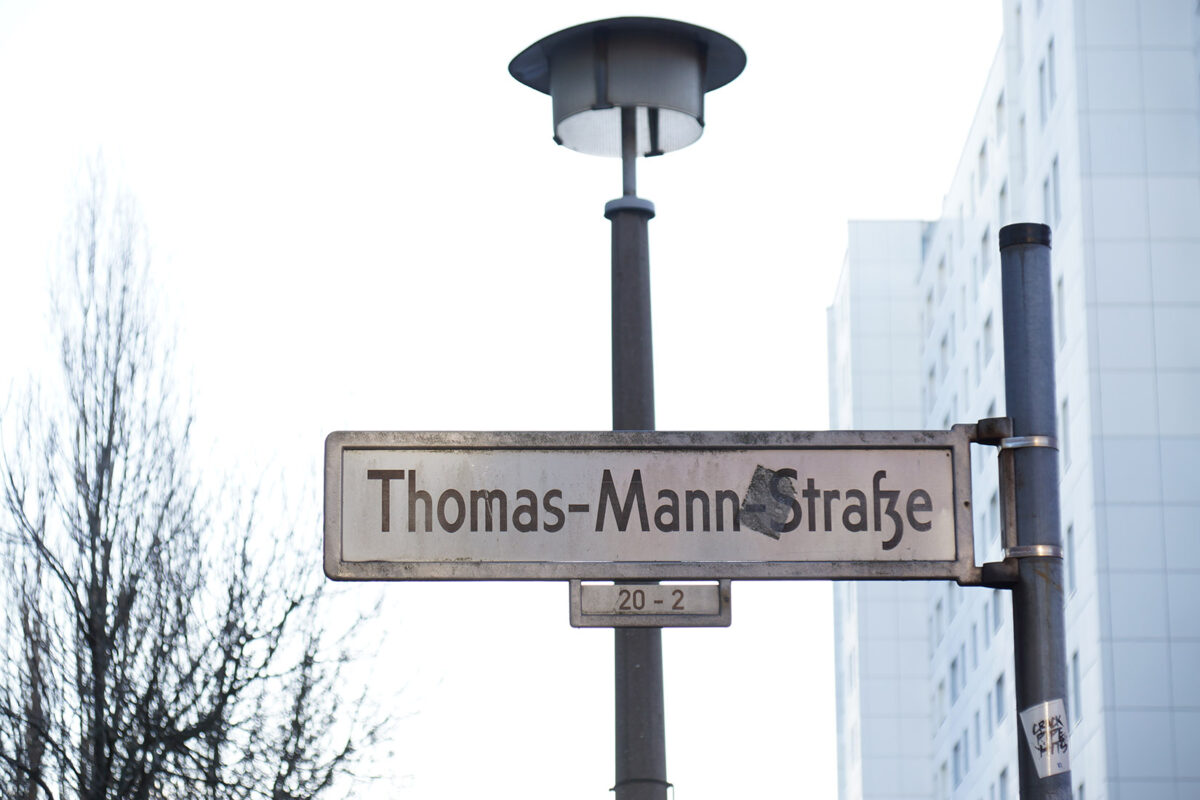
The street is located in former East Berlin, in Prenzlauerberg, branching off from Greifswalder Straße. It was named after Thomas Mann in 1976, during the GDR era. This location can also be seen in terms of memory politics in the other street names, in Mann’s neighbors: the name of the composer Hanns Eisler is affixed to the same post. Like Mann, he fled National Socialism and emigrated to the USA. The two knew each other, met in exile, and had some similar interests, e.g. in the Faust material. In this respect, their spatial proximity makes sense. Beyond Greifswalder Straße, the street continues as Erich-Weinert-Straße, named after the writer who fled to the Soviet Union during the Nazi regime and took on official roles in the GDR after his return.
Thomas Mann, whose political position was not entirely straightforward, somewhere between conservatism and socialism, is thus placed in a context of left-wing, anti-fascist cultural figures. In every city, as research and travel will show, this context looks different, sometimes it is international fellow writers, such as Gustave Flaubert and George Sand in Rome, sometimes it is the family circle, as in Munich with Heinrich Mann. These connections and neighborhoods are part of the culture of remembrance. Street signs and the names on them express appreciation—but also political positions and the mentality of the time.
A street name stands apart from such conscious arrangements in the everyday urban environment, but is influenced and overlaid by it. This results in bizarre relationships; in Berlin, for example, the street name stands in the shadow of a huge red arrow with a pharmacy sign. One might associate literature with a remedy.
Street signs are primarily functional signs, used for orientation and to indicate an address. In Berlin, house numbers are located below the name sign in order to divide a street into sections. When you remove it from this functional context, isolate it, I later realize, its memory function becomes clearer.
The typographic design is also interesting: black on white, in contrast to the white on blue variant used in most cities, such as Munich; a sans serif font, which conveys austerity and a certain harshness. The font is elegant, with the sharp-angled ‘ß’. This is a New Objectivity sans serif font from the 1920s, thus during Thomas Mann’s lifetime …
The writing, but also the materiality and condition of the signs, reveal their historicity. They weather, dust accumulates, black marks form, the sun bleaches the lettering, which has almost disappeared on one sign, and is barely legible, like inscriptions on old gravestones.
On the way back, I pass a cemetery in Mitte, the Old Garrison Cemetery, where years ago, beyond the cemetery wall, I saw a pile of street signs that had been dismantled for a construction site. I remember this now and look for photos I had taken back then, in 2008.
And the idea germinates that an installation with street signs could be a memorial to the Manns. But first I want to find other streets named after the Manns in other cities.
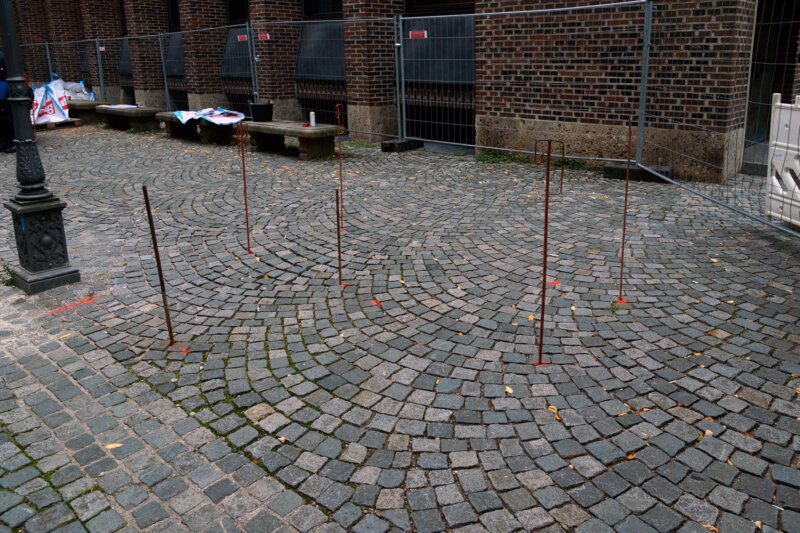
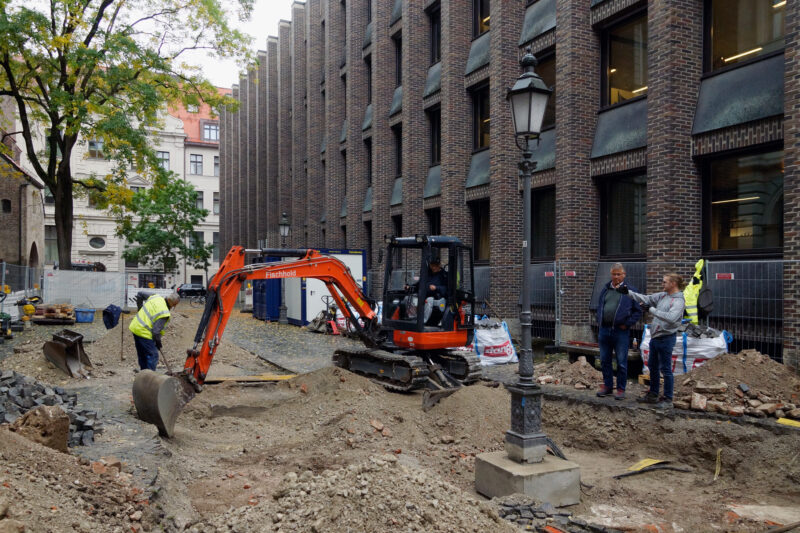
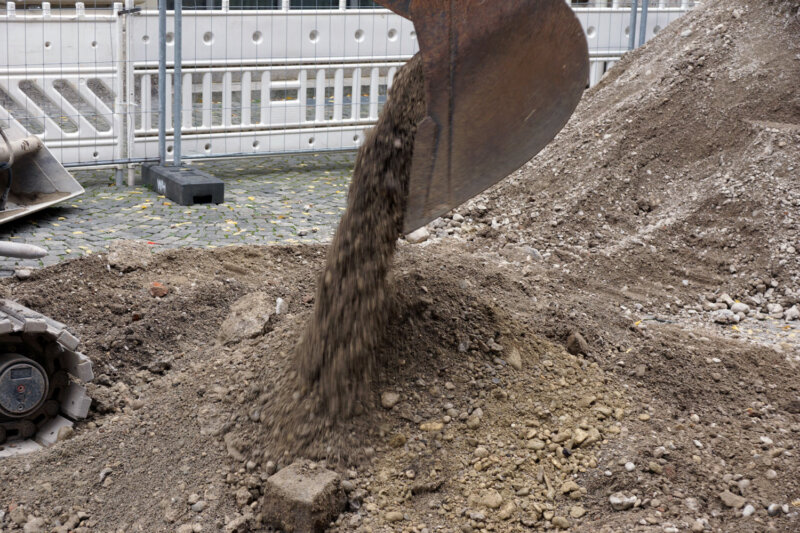
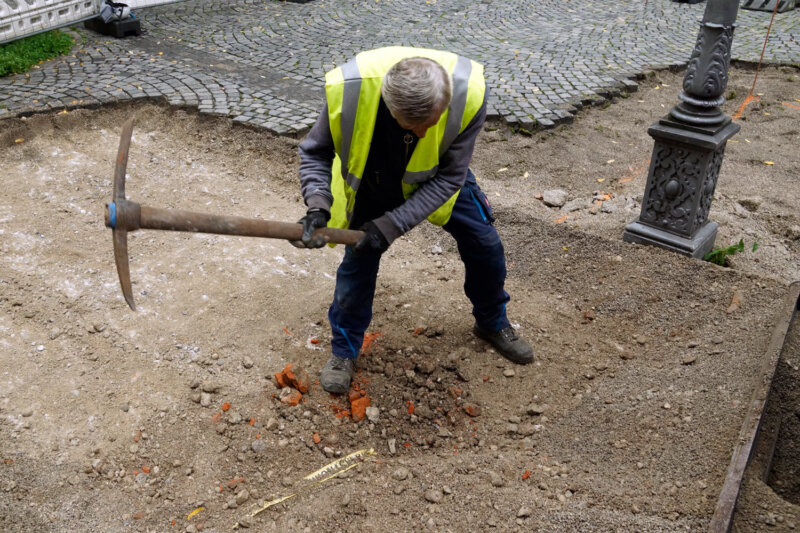
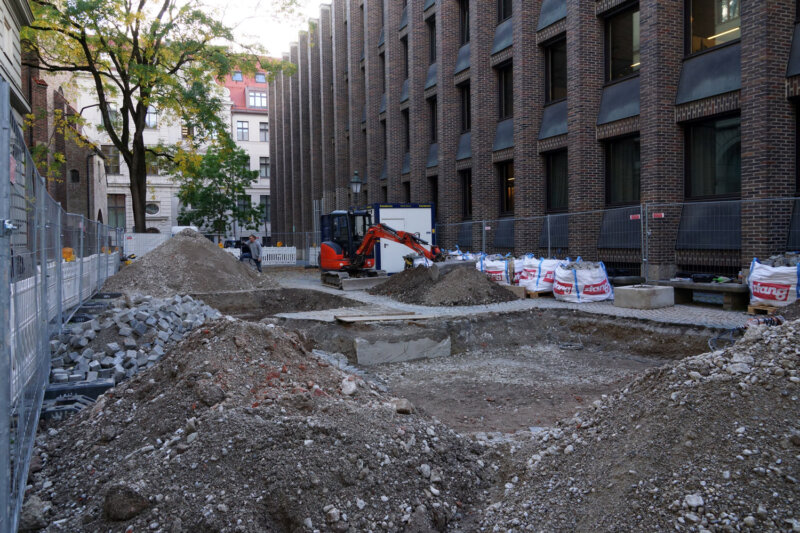
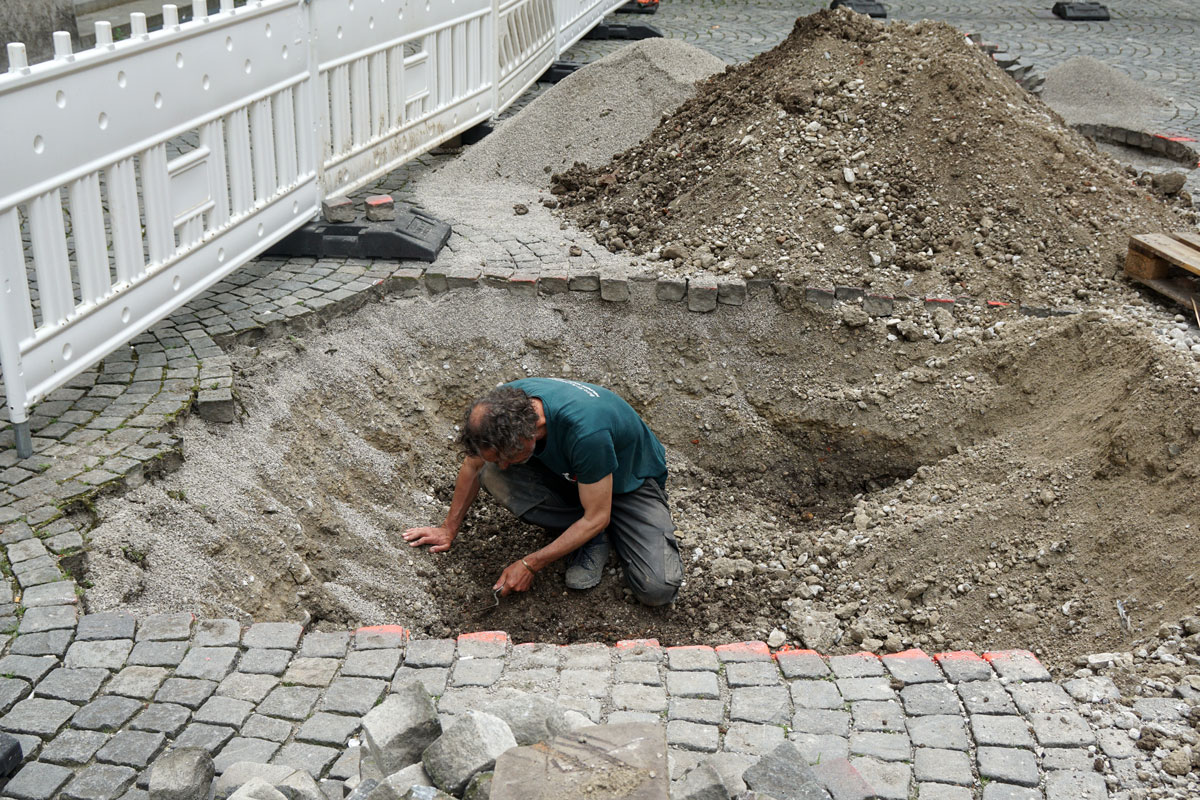
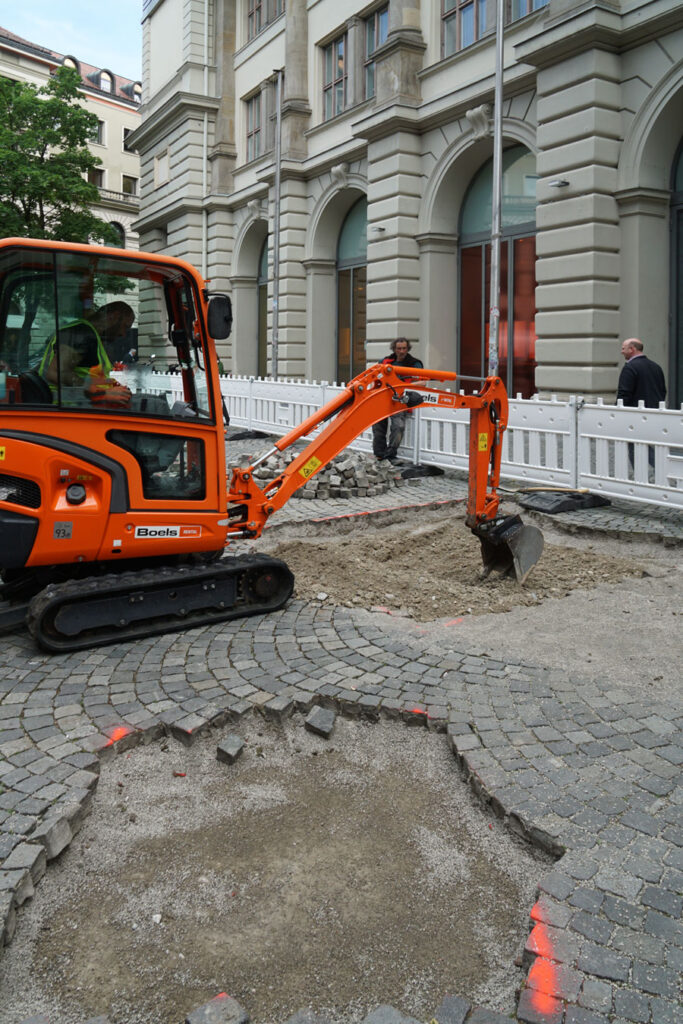
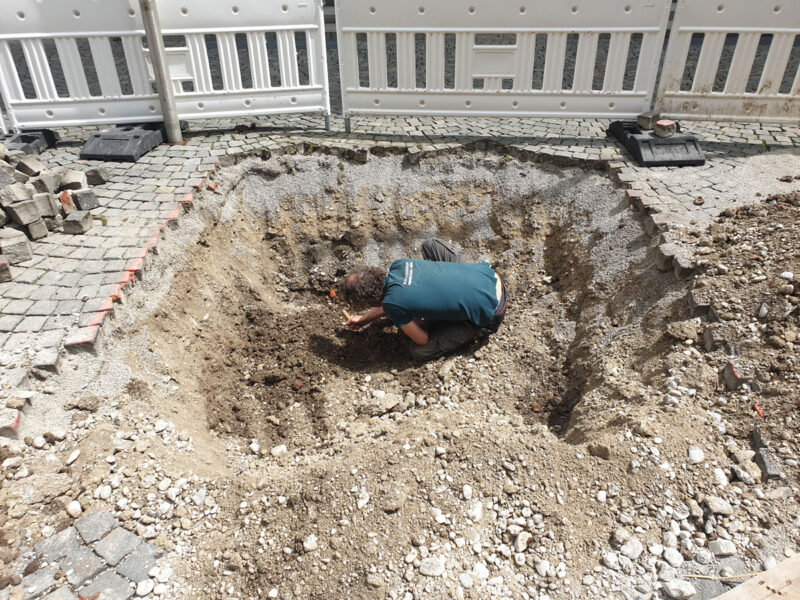
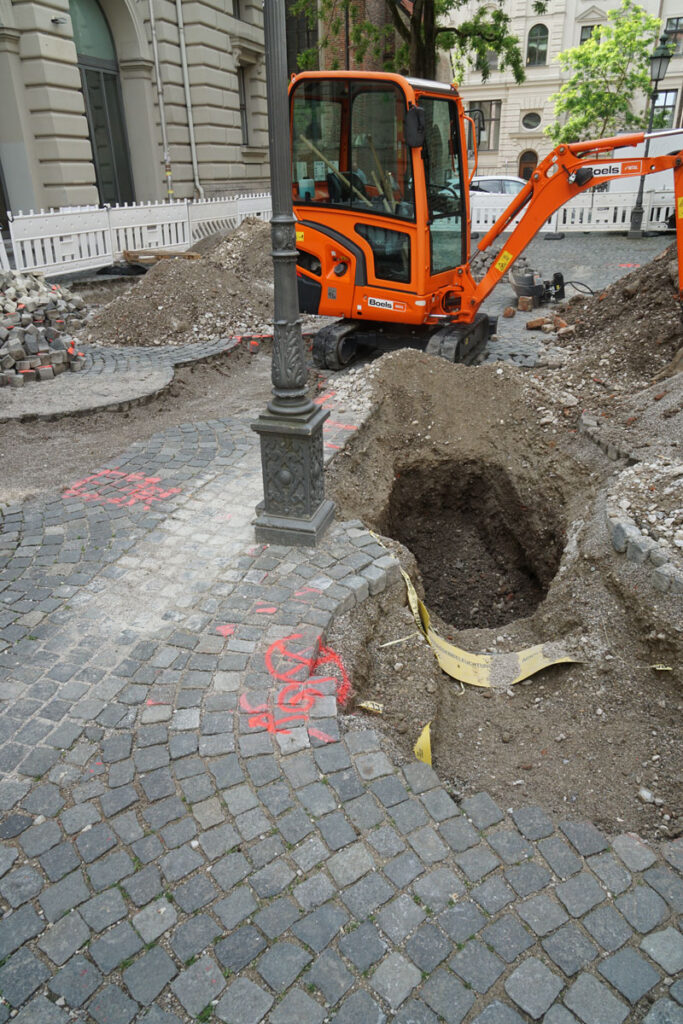
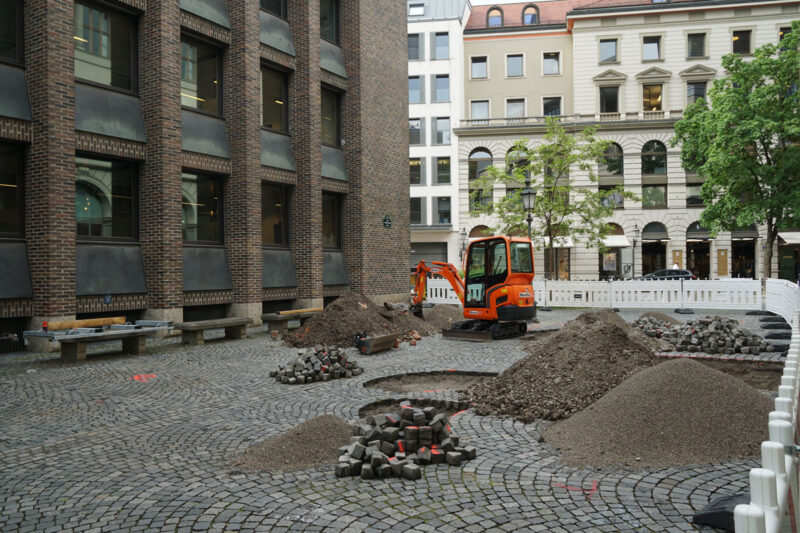
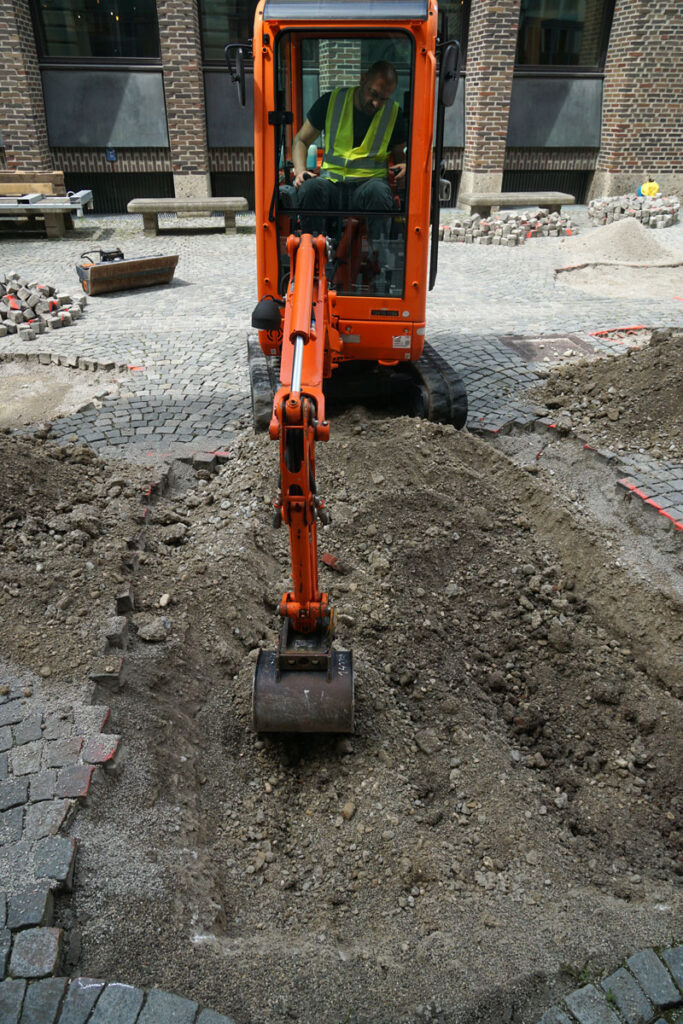
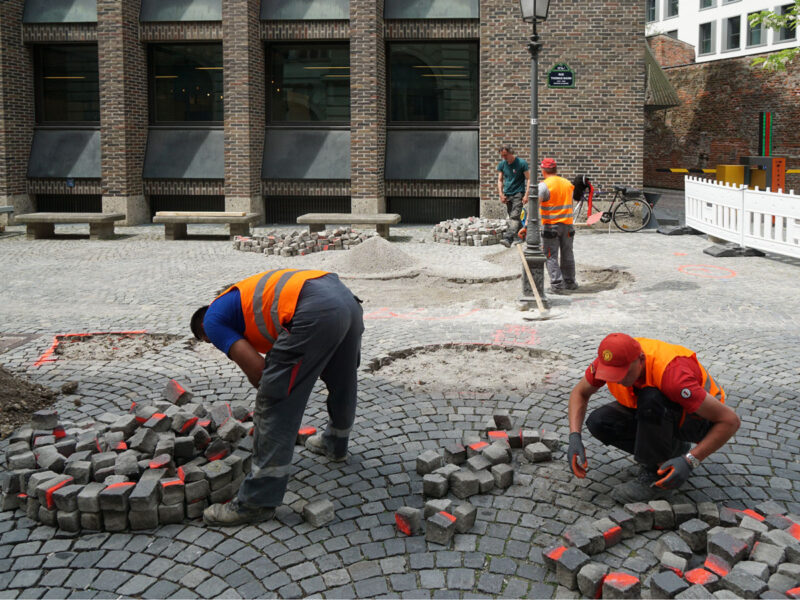
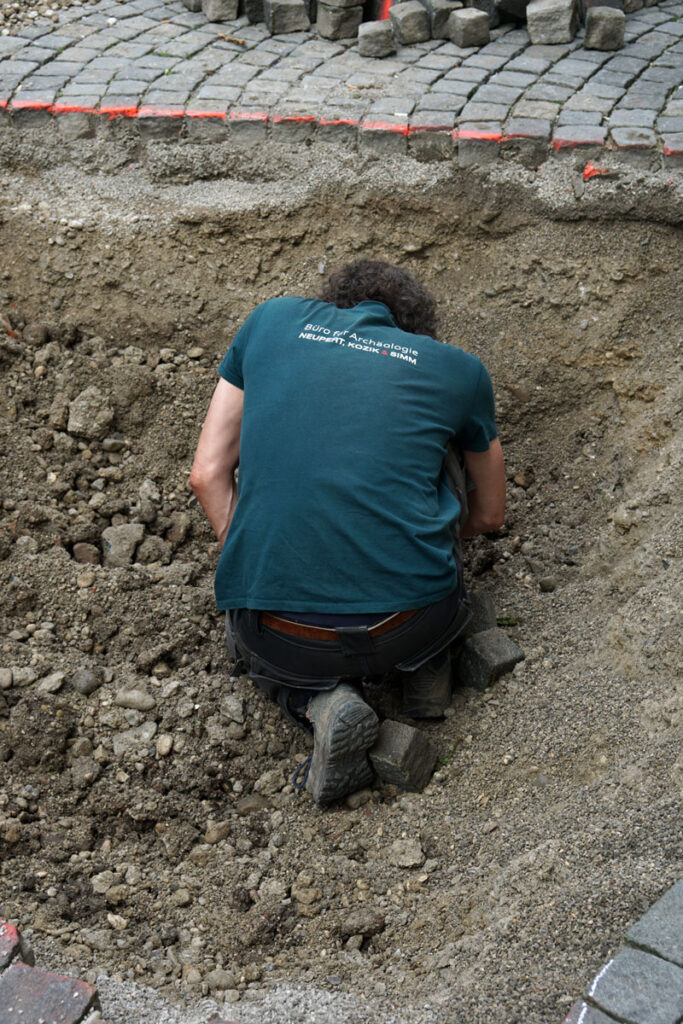
“Deep is the well of the past.” Thus begins Thomas Mann’s novel “Joseph and His Brothers”. And indeed, for the monument to the Mann family and its foundations, excavations are being carried out, archaeological investigations are taking place, and soil samples are being taken. Construction work has been underway again on Salvatorplatz since September 22, 2025.
The plans are based on designs by Frosch Wollmann Architektur. The archaeological work is once again being carried out with great expertise by the archaeology firm Neupert, Kozik & Simm. The construction company K&M Ramaj has been commissioned to carry out the work. The masts, lights, and signs are being prepared by the Munich Building Department.
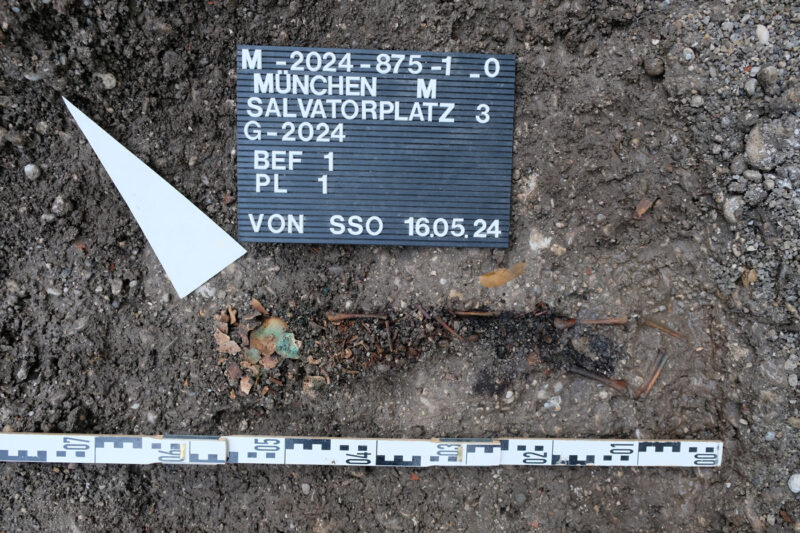
In May 2024, during the mandatory archaeological monitoring of the excavation at Salvatorplatz for the erection of the monument to the Mann family, remains of burials were discovered in the cemetery of the nearby Salvator Church and the cemetery wall. Neupert, Kozik & Simm Archaeology Office was commissioned to carry out the work and recovered a child’s skeleton from the Baroque period. The cemetery was in use until around 1800.
This was actually known, and the cemetery is also designated as an archaeological monument, but it was assumed that no finds were to be expected due to the numerous construction measures on the square after 1945 and an air-raid shelter under the square. However, during an inspection of the basement beneath the Salvatorgarage, it was discovered that it is located entirely beneath the building, with only a narrow passageway beneath the square.
Excavating the entire site down to the planned foundation depth of up to 1.90 m in some places and having it archaeologically examined would have been very costly and time-consuming, so it was necessary to halt construction and then dismantle the building until the situation had been clarified.
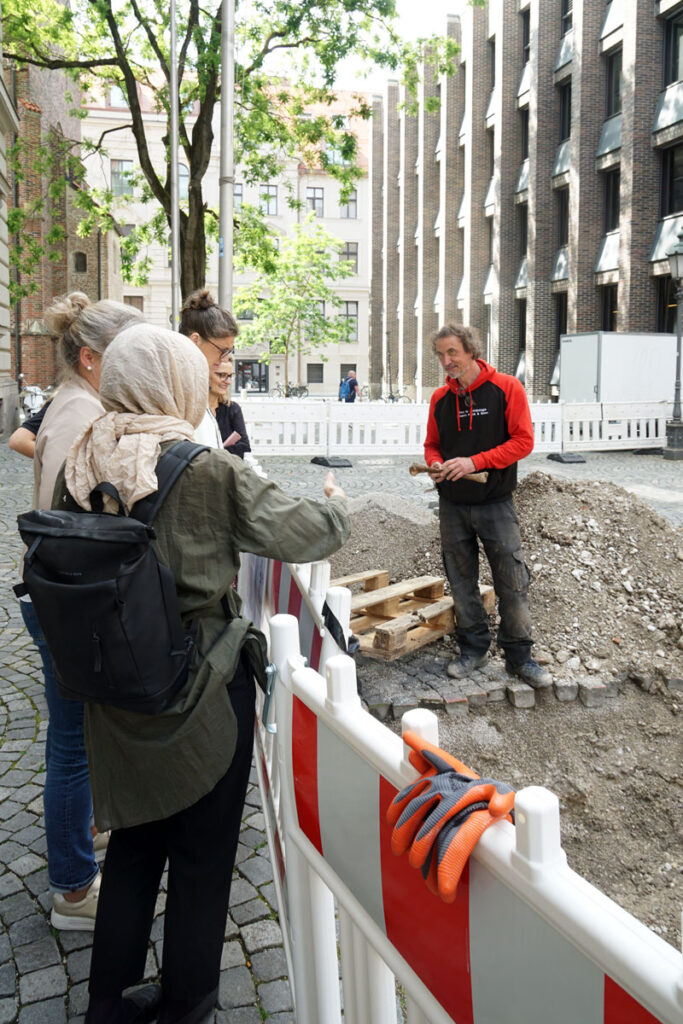
The finds, especially at the start of construction, were a hard blow and left me in conflict: on the one hand, I am interested in history and archaeology myself; viewing, collecting, and documenting finds are part of my artistic practice. And the excavations also attracted the interest of passers-by and employees of the Literaturhaus. For a short time, Salvatorplatz was transformed into an excavation site where the remains of past lives and former city dwellers became visible—an exciting process in itself. And it seems fitting that the Mann family should have a memorial here, where traces of other families’ lives are also visible. On the other hand, the finds prevented the long-awaited completion of the memorial project, which has been dragging on for several years.
The excavations set in motion a series of renewed coordination processes with the monument protection authorities, including the Bavarian State Office for Monument Preservation, where the project at Salvatorplatz seemed to be called into question at times, not with regard to the archaeological monument, but in principle; departments that had apparently not been involved before got involved, the State Monument Council—a body I had never heard of before—was asked for its opinion and referred the matter back to the monument preservation authorities, who asked me to submit a new project description with visualizations that would more clearly show the effect on the “Munich after 1945” ensemble…
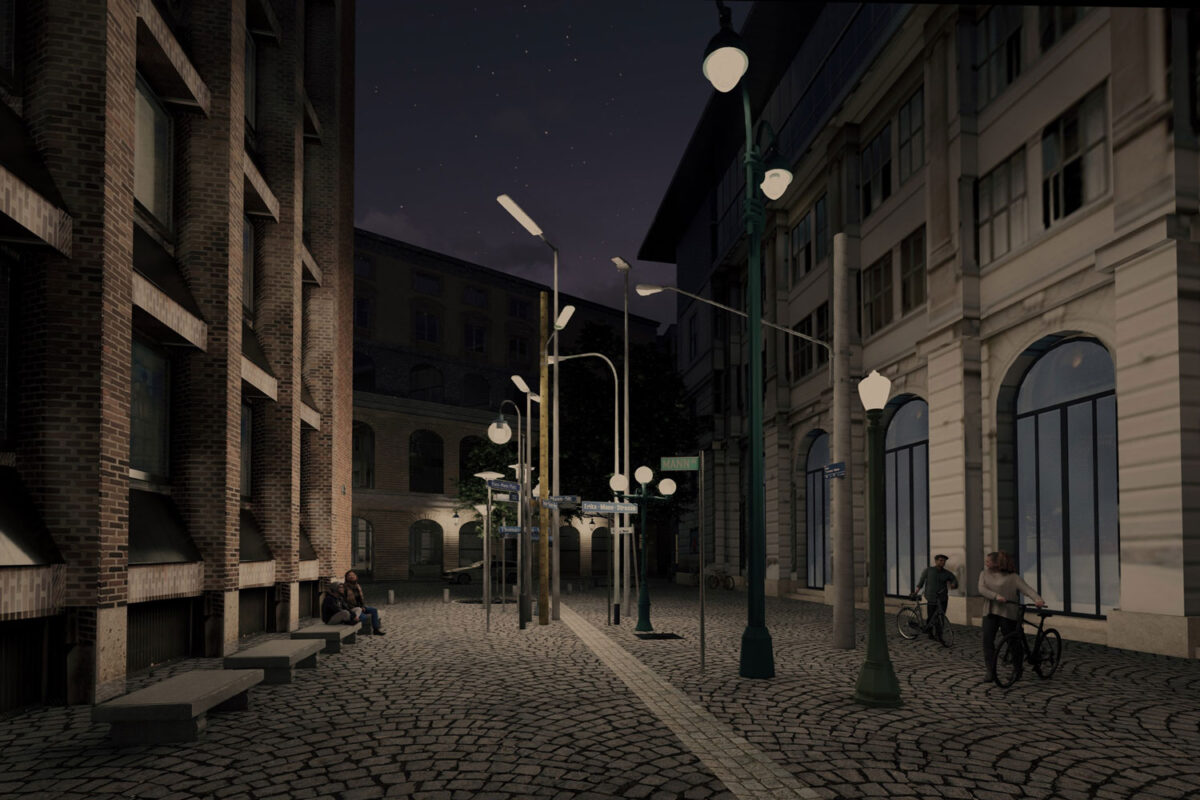
So the central location in the old town has its pitfalls. Nevertheless, the location remains ideal for the monument in terms of content, in the immediate vicinity of the Literaturhaus, with its connection to literature and in particular its “patron saint” Thomas Mann. I had also designed the monument specifically for this square, as a gathering of the signs scattered throughout the city in a central location, with the towering, light-giving luminaries. At the beginning of 2025, the monument protection authorities signaled their fundamental agreement with the monument, which manifested itself in a permit for further (archaeological) excavations. Now, in accordance with the recommendation, the foundations for the lights must be planned to be flatter, and technical solutions must be found for the changed starting position. The planning is now continuing! Frosch Architects have been on board since May 2025.
I hope that the monument project will be completed, if not in the Zauberberg year 2024, then in the Thomas Mann year 2025!
Rue Thomas Mann, Paris, 2018, Photo: Eva-Maria Troelenberg
As the first component of the memorial to the Mann family, „Rue Thomas Mann“ in the characteristic Parisian design was installed on Salvatorplatz in Munich in April 2024, on the façade of the Salvator garage.
It refers to the street in Paris that has commemorated the „Ècrivain allemand“ since 1995, as the sign also says. It is located in the 13th arrondissement, in the modern „Gare“ district, which was redesigned at the same time as the street was named, in the neighbourhood of the Bibliothèque François-Mitterrand (National Library of France, BnF), which makes the choice of the writer as the namesake all the more plausible.
The sign symbolises the literary and political Franco-German relationship and the role Thomas Mann played in it. He held the Goncourt brothers, among others, in high esteem and drew decisive inspiration from their works for his family novel „Buddenbrooks“. And he was the first German writer to make a public appearance in Paris after the First World War to give a speech entitled „The intellectual tendencies of contemporary Germany“. In the role of an unofficial cultural ambassador of the Weimar Republic, Mann promoted Franco-German friendship and international understanding – see also his report on the trip and his stay, „Pariser Rechenschaft“[Parisian Account]. The naming is also a reflection of the later political relations between the two countries, which intensified in the 1990s.
The installation on Salvatorplatz was preceded by a lengthy process of research and contact, including via the Goethe-Institut Paris. In the end, the city of Paris approved the reproduction of the sign, which was carried out by the company LACROIX Signalisation/Signaclic, which also works for the city of Paris.
As street signs in Paris are predominantly attached to building facades, it was necessary to find a suitable location in Munich. The façade of the Salvatorgarage was an obvious choice, for which the consent of the Office for the Preservation of Historical Monuments was obtained, as well as the tenants and owners, Bavaria Parkgaragen GmbH and Bayerische Hausbau.
The installation itself was carried out by Florian Froese-Peek in collaboration with Albert Coers.
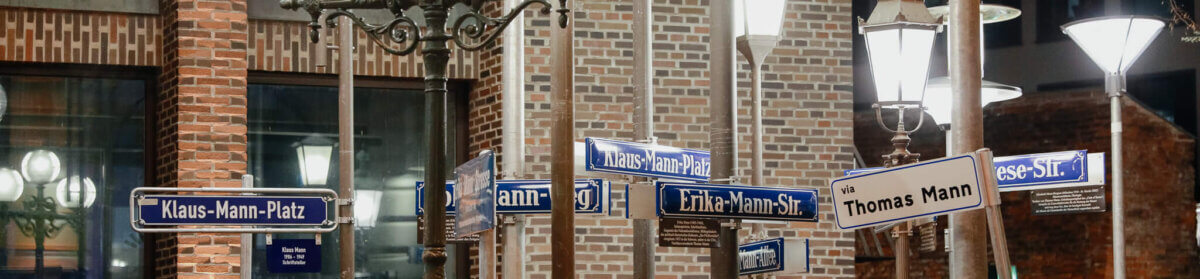
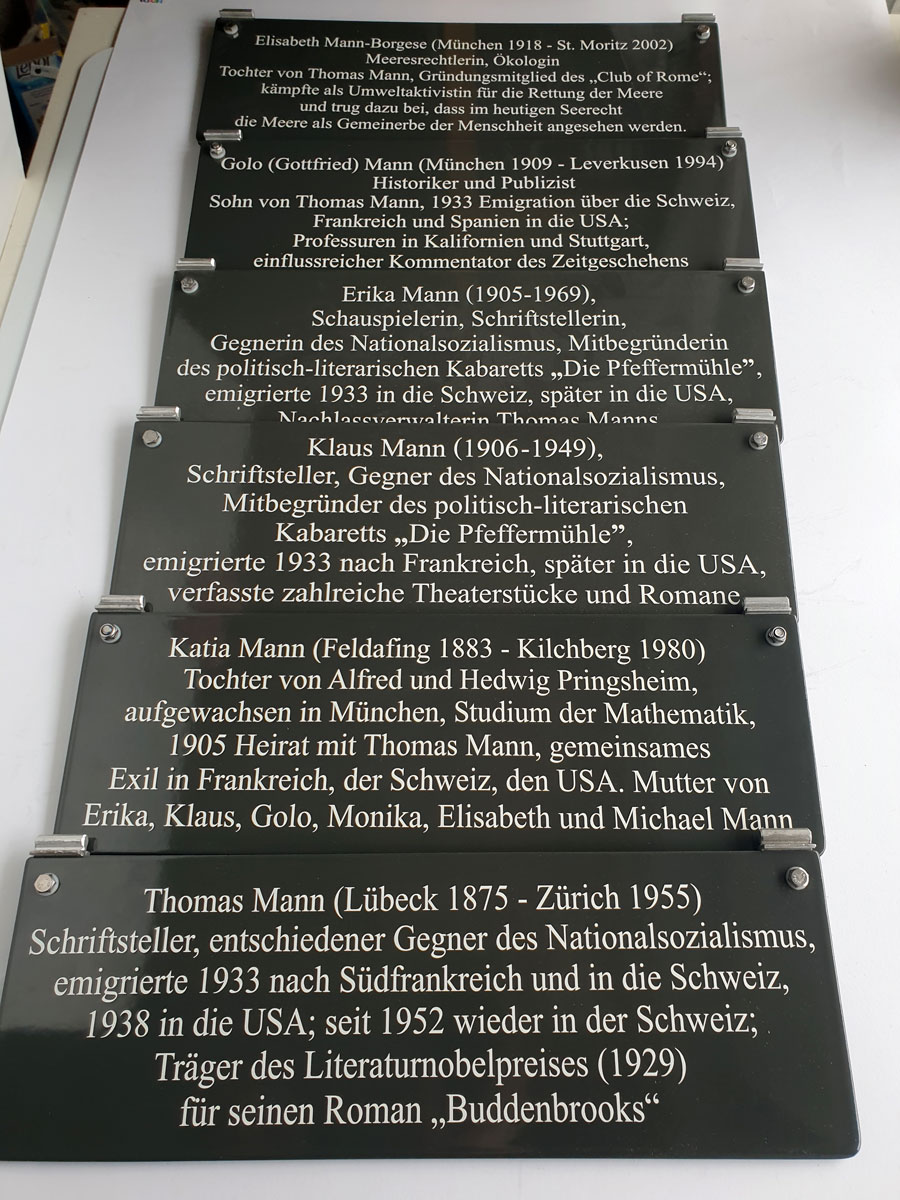
In addition to the street signs with the names of the Mann-familiy from Munich, boards have been completed that provide information about the members of the family and are placed below the signs. Additional information is therefore an integral part of the monument. The texts were created in collaboration with the Cultural Department of the City of Munich, Public History Department. They provide brief biographies of Thomas, Katia, Klaus, Erika, Golo Mann and Elisabeth Mann. The Munich building department took over the technical implementation. Until now, these signs were only available for Thomas, Klaus and Erika Mann. In this respect, it made sense to me to provide all Munich street names with such signs and to add ones for Katia, Golo and Elisabeth Mann. The signs are made of enamelled metal and are therefore quite heavy compared to their size (15 x 45 cm). Reason to place the signs on a bathroom scale – and test the weight of the names and information.
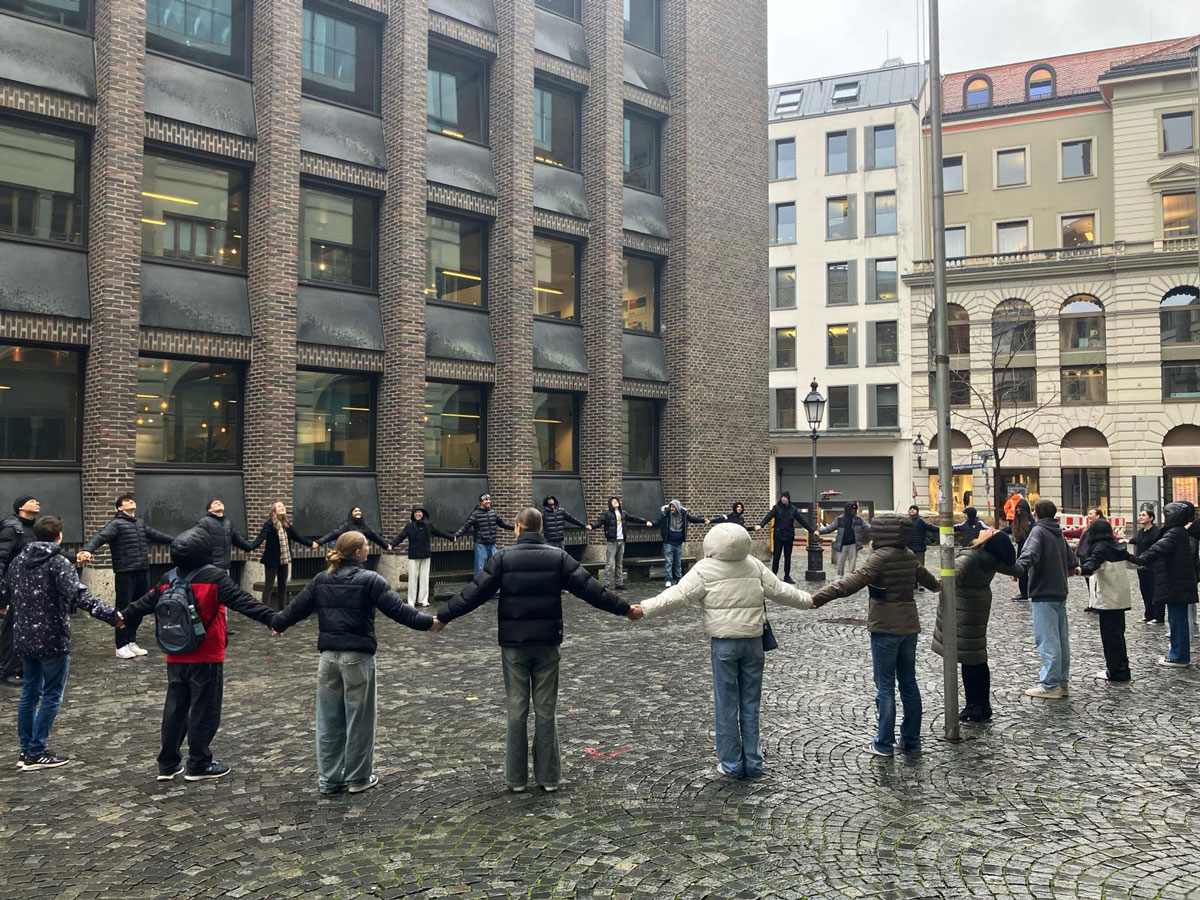
The Salvatorplatz in Munich, where the memorial to the Mann family is to be erected, is „pre-warmed“ and activated: students from the Thomas-Mann-Gymnasium and the middle school on Peslmüllerstrasse, Pasing physically explored the square on March 6, 2024, where they formed, among other things. a living chain around the area where street signs and lights will stand in memory of the members of the Mann family. And that in the rain! The action is part of a program to teach art in public spaces in schools, led by Barbara Dabanoglu.
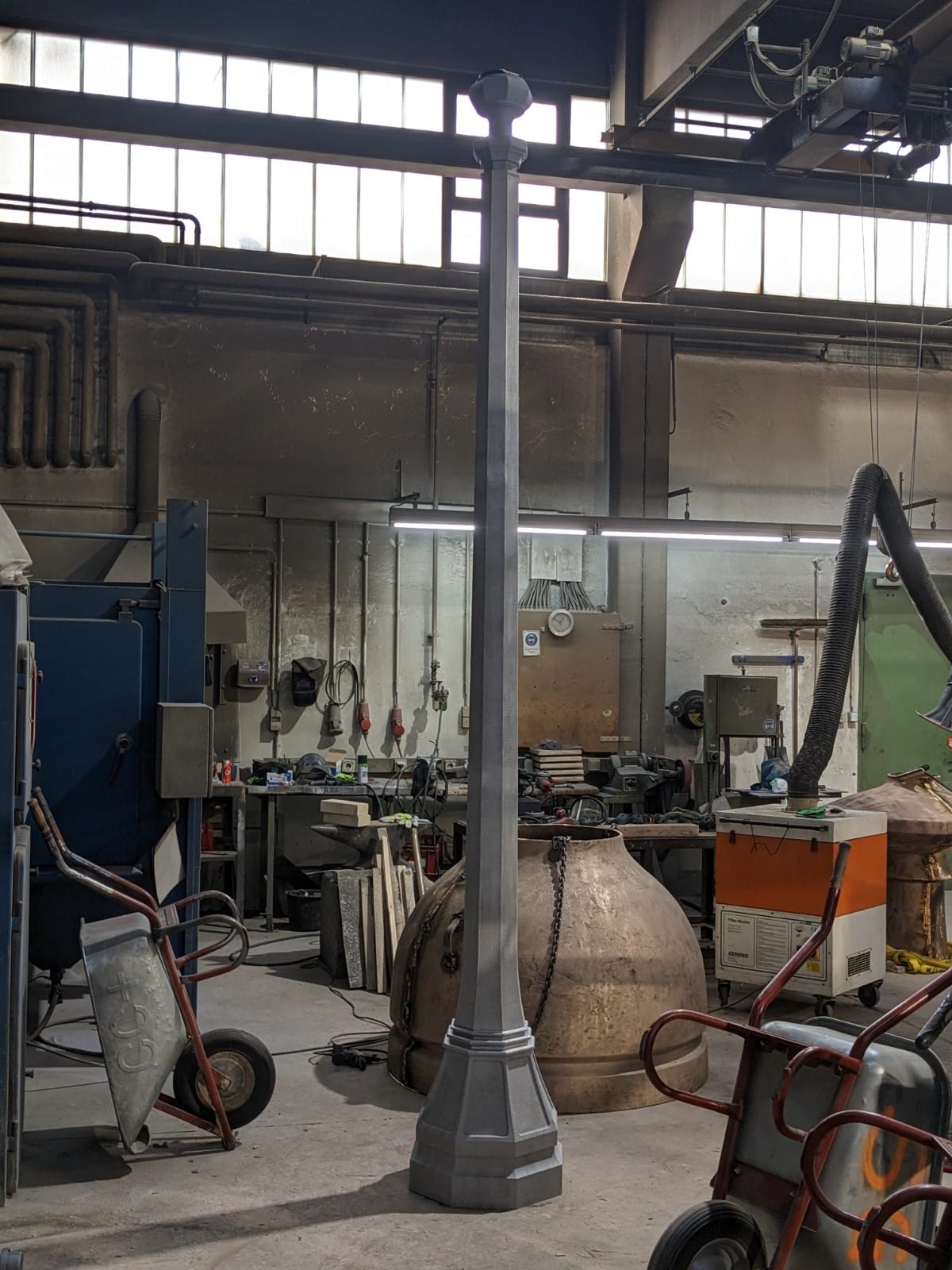
These days the luminaire was completed, which within the memorial refers to the one in Pacific Palisades/Los Angeles that stands there in front of the house that Thomas Mann lived in with his family during his exile in California, today’s Thomas Mann House. The art foundry Anton Gugg made an aluminium casting for it. Once again, this marked the end of a lengthy process: based on photos I had taken in 2019 and plans by Public Works Los Angeles, a digital model of the light was drawn, by artist Florian Froese-Peek, transferred with a 3D printer into a three-dimensional 1:1 model made of plastic, then cast using the melt-out process. I had visited Pacific Palisades in autumn 2019 – see the blog post. For a long time I had researched and tried to get a light from there – which turned out to be difficult. Transporting it to Germany would also have been a lengthy undertaking, as I found out with the example of the luminaire produced in the USA based on the model in New York. In the end, I followed the advice of Bob Gale, screenwriter and film producer (including „Back to the Future“), who lives in the neighbourhood. He wrote at the time: „My suggestion is that you have the fixture extensively photographed and measured, and then duplicate it in Germany. This would be the most cost effect and simple solution.“ This suggestion certainly does not come by chance from someone who is at home in the film industry, which often works with props and replicas. And perhaps the concept of replicating a luminaire from the 1920s/30s using modern digital, but also traditional methods, for a monument that is to be erected in the future – presumably in spring 2024 – also fits the motto „Back to the Future“.
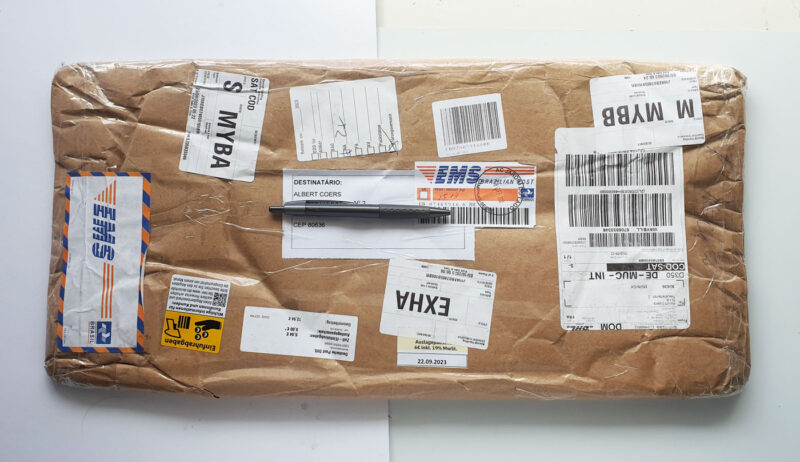
After a long journey, in October 2023 the last of the signes arrived that will be part of the monument to the Mann family. It came from Brasil: a copy of the sign of Rua Thomas Mann in São Paulo. CSV Sinalização in Campina/São Paulo produced it in close collaboration with Albert Coers. As it arrived, covered with stickers and stamps of customs, mail, delivery, it is an object of Mail Art, too.
A few days ago, the municipality of Sanary-sur-Mer in the south of France made a contribution to the memorial for the Mann family with the lamp or candelabra, as historical lamps are often called. In autumn 2020, I visited the former emigration site of the Mann family.
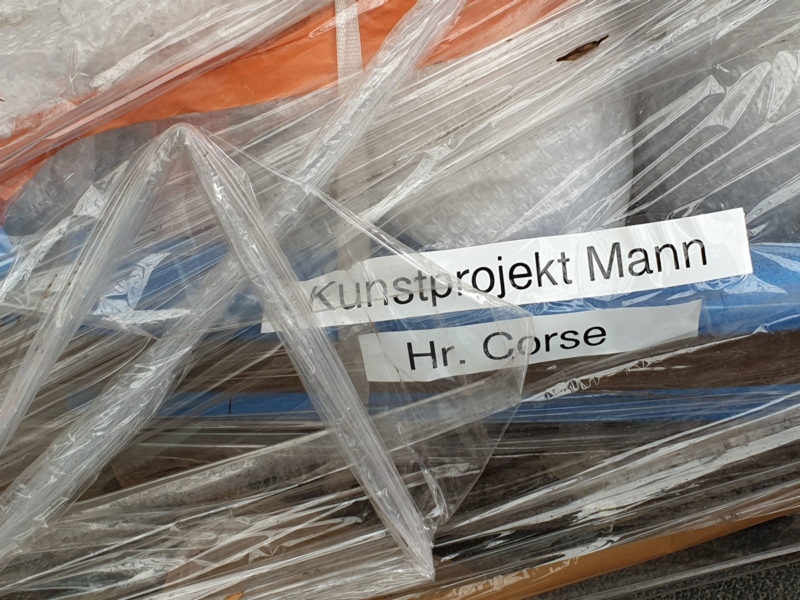
The candelabra came well packed from the Fonderie de Roquevaire, which had restored it, and was received at the Bauhof in Munich, measured – and labelled. As a small side effect, the letters in my name got mixed up and I became a „Cors(ican)“.
On 3.9.2021 Albert Coers will give a lecture on the memorial for the Mann family, at the online conference „Vor Ort: Erinnerung, Exil, Migration“, annual conference of the Gesellschaft für Exilforschung in cooperation with the NS-Dokumentationszentrum München, 3.–4.9.2021.
The annual conference 2021 deals with places of exile and migration and their relation to cultures of memory and stimulates exchange between exile research and other research fields dealing with (forced) migration and flight.
More information, program and registration here.
On 21. 3.2021 there was as a broadcast on Bayern 2 in the Kulturjournal the radio feature „Schöner Schilderwald [Beautiful sign forest]. The artist Albert Coers and his Munich monument to the Mann family“ by journalist Astrid Mayerle, based on an extensive interview. Listen to it here.
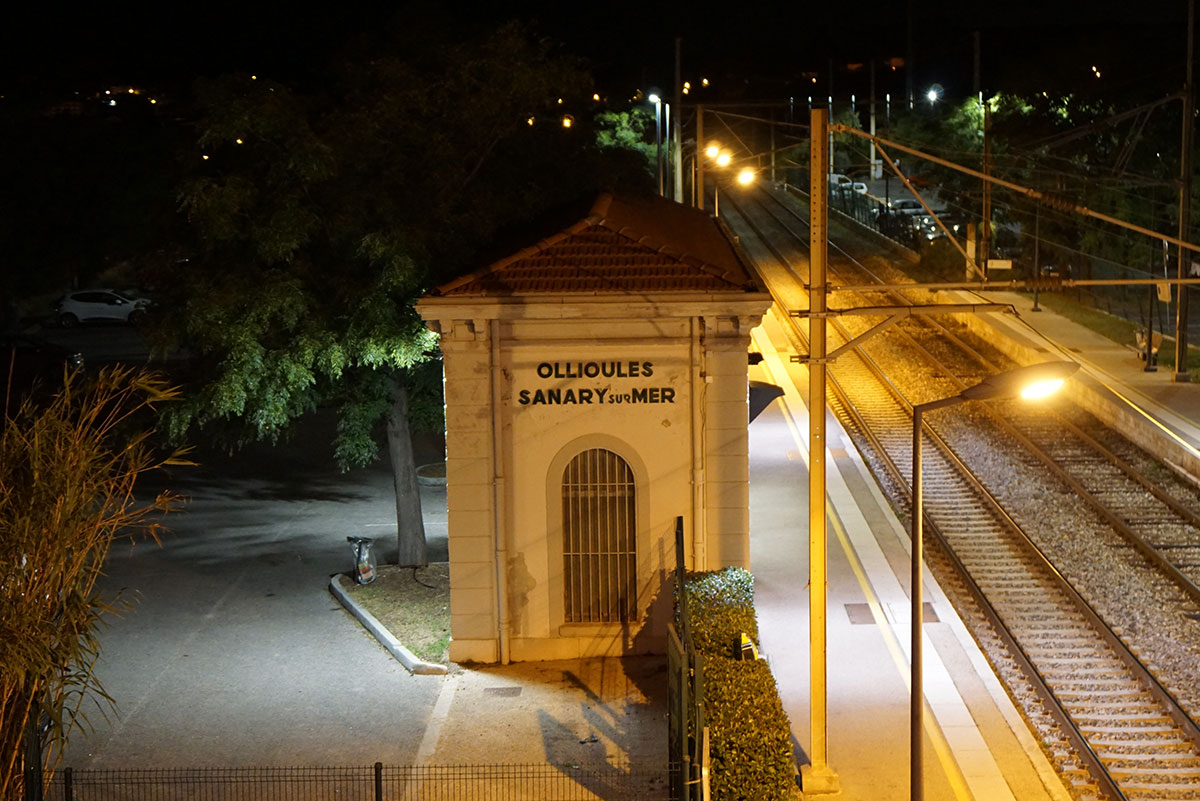
A journey at the end of September, which I make despite Corona concerns: I arrive by train from Marseille around midnight. The station, built for the towns of Ollioules and Sanary-sur-Mer together, is deserted but brightly lit – which puts me in the mood for the theme of the lights. On the temple-like façade, which heralds the grandeur of the small towns on the Côte d’Azur, the names are written in large letters. So I have it in black and white that I am in the right place. The place where many German-speaking emigrants met in the 1930s, including the Manns.
On October 6th I’m in Frankfurt again for a local appointment: to receive the street signs from Klaus-Mann-Platz, which will be part of the monument to the Mann family in Munich.
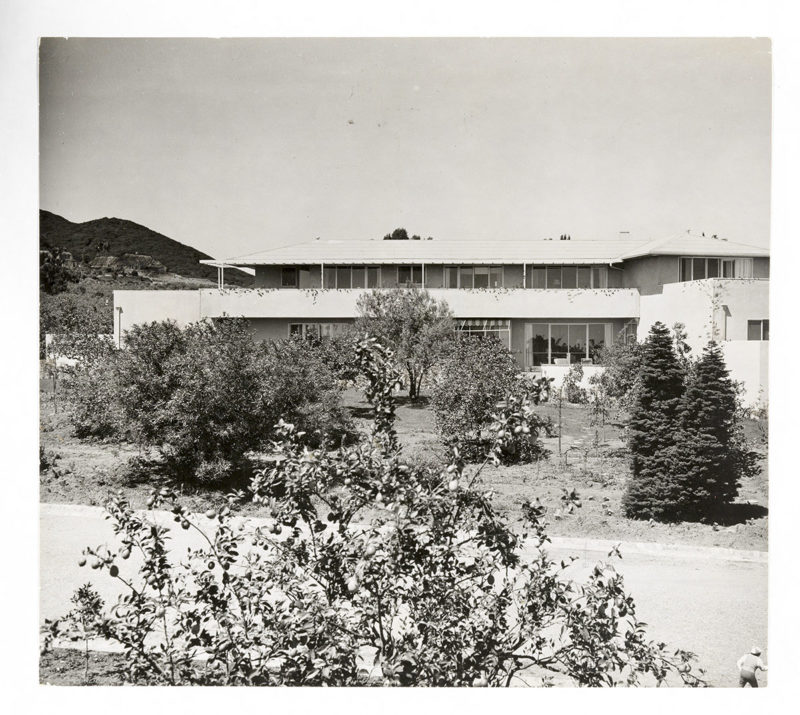
In 1941, Katia and Thomas Mann moved from Princeton to the West Coast, to Los Angeles – the decisive factor being the prospect of being able to live in a villa they had built themselves and no longer rented, thus leaving behind their emigrant status and putting down roots in the USA. Added to this are the landscape and the weather: „The sky is bright here almost all year round and sends out an incomparable, all-beautifying light“ (TM to Hermann Hesse).
Haus Thomas Manns, ca. 1942; Design & Architecture Museum; University of California, Santa Barbara
LA – a bleak picture?
But in autum 2019, when I planned visiting Thomas Manns home, I had been warned by a driver I was travelling with on the East Coast, in Maine: „You may give going to LA some serious thought. Things there are pretty tough.“
And Georg Blochmann, director of the Goethe-Institut in New York, also paints a bleak picture: LA is a symbol of the failure of the American Dream, with extreme social segregation and the dysfunctionality of public infrastructure, including public transport.
The stay will be about contrasts. In the social aspect, between public and private, the light of the metropolis and its dark sides.
In this respect, I am interested in public transport and how it can be used to get to Thomas Mann’s former home in this car-dominated city – even though he never took the bus in LA, but always drove his own car (he did not have a driving licence, unlike Katia and his children, of whom Erika and Elisabeth in particular were passionate drivers, probably a terrain of the female Manns).
It all takes quite a long time, but works surprisingly well overall. Once again, it takes an hour and a half, which is already typical for other cities, to get from the city centre to the destination associated with the Manns. It’s off to Pacific Palisades, on the hilly western edge of the metropolis. This time there are no problem neighbourhoods or commuter suburbs on the periphery, but villas. By bus towards Santa Monica and Beverly Hills, then another in Westwood;
Get off at the Sunset/Capri stop, up San Remo Drive. Even the name „Drive“ indicates that you normally get around here by (car). Lush gardens, palm trees, sweeping and mowing, mostly by Hispanics or blacks. After several turns, a place that looks familiar to me from my virtual tours via Google Earth, where high hedges and trees form a wall-like corner, behind which the house lies like Sleeping Beauty. Here again the need for privacy seems to manifest itself; and time has done the rest.
San Remo Drive
Get off at the Sunset/Capri stop, up San Remo Drive. Even the name „Drive“ indicates that you normally get around here by (car). Lush gardens, palm trees, sweeping and mowing, mostly by Hispanics or blacks. After several turns, a place that looks familiar to me from my virtual tours via Google Earth, where high hedges and trees form a wall-like corner, behind which the house lies like Sleeping Beauty. Here again the need for privacy seems to manifest itself; and time has done the rest.
A light fixture has grown into the bushes. Another one faces the driveway of No. 1550; on it the street names „Monaco Drive“ and „San Remo Drive“, evoking the Mediterranean, the fashionable coastal towns of the Riviera (the neighbourhood is also called that), in whose flair Los Angeles likes to share. But one could also associate (Italian) „Monaco“ with „Munich“, and thus be with Thomas Mann’s former residence.
Original-Reconstruction?
As in New York, it is interesting to know who is responsible for the lights and can provide information about them. It is the city’s Bureau of Lighting, to which I paid a visit. But in this „residential neighbourhood“, the residents themselves also take an interest. Bob Gale, author of the screenplay and co-producer of „Back to the Future“ lives in the area (incidentally, so does Armin Mueller-Stahl, who portrayed Thomas Mann in the series „The Manns“), is president of the local homeowners’ association and is very familiar with the different types of lamps and their history, even sending photos of them. He recommends reconstruction in Germany as the most economical method of obtaining lamps – probably also because he comes from the film industry.
The question of original/reconstruction will continue to occupy me; it is also relevant to Thomas Mann’s former residence and the way it is treated. First of all, however, I am quite happy to see the luminaires in their spatial context on site.
The lamps, especially when they stand so overgrown and ramshackle in the bushes, tell of the city’s ambition, its grandeur, its façade-like quality. Installed in the 1920s to 1940s, they stood here when Thomas Mann moved into his newly built Bauhaus-style residence – which was more modern compared to the historicising, opulent lamps.
Inside Thomas Mann House
In 2016, the German state acquired the house and set it up as the Thomas Mann House as a residence for scholarship holders, a place for meetings and events. Nikolai Blaumer, programme director, leads me through the house and garden. The library is being reconstructed, books are arriving from many places and institutions, including Yale.
The impression: it’s a good place to work. The furnishings are functional, new, comfortable, without excessive luxury. The reference to Thomas Mann is also pleasantly restrained: a few photos, but no hagiographic staging in which the person of the former landlord would follow you at every turn. Meet scholars, including the Germanist Stefan Keppler-Tasaki. Talk about the memorial project. He knows a lot about the Manns and their contemporaries.
As in the garden with its high hedge, there are also elements in the architecture that demarcate and emphasise a space of their own: the wall drawn forward from the corner of the study, which, at Thomas Mann’s request, was to provide protection from view and noise.
From the garden you have a view over to the hill range with the former house of Lion Feuchtwanger, today as Villa Aurora also a residence for artists, writers, musicians. Next to it is the Getty Museum. Even further away, perched on a hill, is the Getty Center. The area is full of big names, institutions and buildings.
As I return from San Remo Drive, I catch the bus heading into the city – with the same bus driver as on the outward journey – and am greeted casually by a man in a mint-coloured shirt: „Take a seat, relax, cold drinks will be served.“ Californian relaxation.
A few days later I’m back at the Manns’ former home. Francis Fukuyama is giving a short talk, along the lines of the radio addresses „German listeners!“ Thomas Mann’s in the 1940s. Fukuyama expects a strengthening of the left/liberals as a reaction to Trump, and is „not too pessimistic“ about the future.
At the small reception afterwards, to my surprise, I meet Thomas Demand, who has lived in LA for ten years. With regard to the memorial, he recommends Chris Burden’s installation of hundreds of street lights in front of LACMA to me. It has become a favourite of the public, a landmark of the museum, even of the city, in that ubiquitous elements of public space with which residents identify are brought together in a concentrated way and strictly ordered according to their size – so that they can be seen from a distance.
For a moment, I feel like I belong to the scholarship holders; besides those from the Thomas Mann House, there are also some from the Villa Aurora. LA turns out to be an interesting hotspot, despite or perhaps because of the stark contrasts, of architectural landmarks and rampant homelessness, of glamour and neglect. I regret that I can’t stay longer. I have to continue my journey to Brazil, to São Paulo, my last stop.
By chance, now, at the end of my stay, I am asked to evacuate: there is a fire. When, during a visit to the Villa Getty, a reconstructed villa from Pompeii, there are clouds of smoke in the sky and it is raining ash, it is strangely fitting.
On 10.4.2019, the plenary assembly of the Munich City Council decided to realize the design of Albert Coers. Coers’ concept, which has won an invited art competition of the cultural department, bears the title „Straßen Namen Leuchten“ [Streets names lights].
Previously, on 28 March 2019, the City Council’s Culture Committee had unanimously decided to follow the jury’s proposal and award the contract for a „Memorial to the Mann Family“ at Salvatorplatz to the artist, who lives in Berlin and Munich .