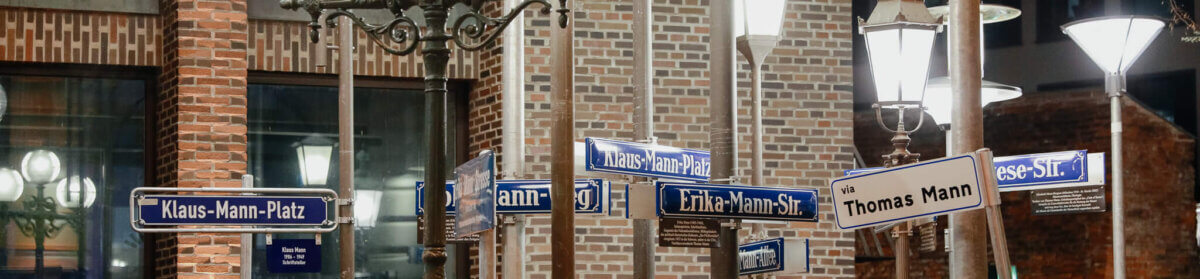
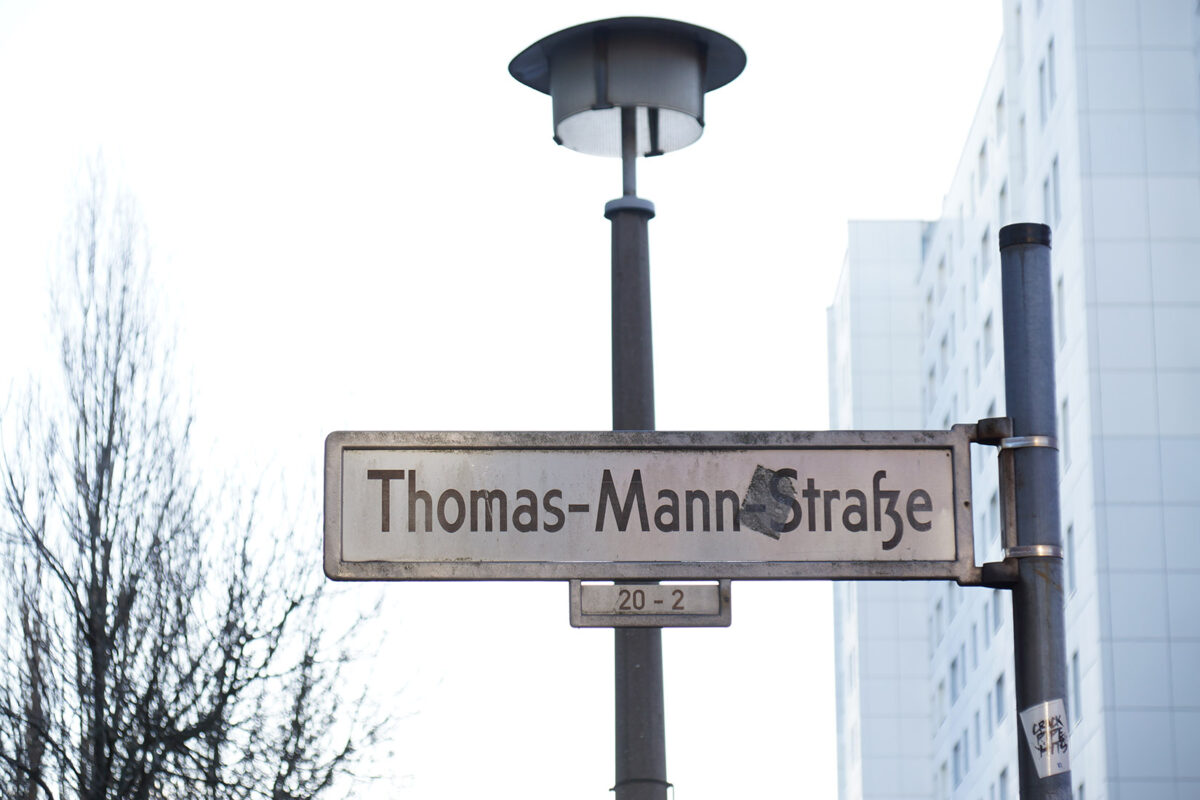
In June 2018, I cycle to Thomas-Mann-Straße in Berlin. In my diary, I’ll write afterwards: ”Idea for monument takes shape: street signs.“ The visit is about gathering ideas, getting inspiration from the location. I had seen that there was a swimming pool named after Thomas Mann there, and I had many associations: swimming, waves, water, Death in Venice …
The street is located in former East Berlin, in Prenzlauerberg, branching off from Greifswalder Straße. It was named after Thomas Mann in 1976, during the GDR era. This location can also be seen in terms of memory politics in the other street names, in Mann’s neighbors: the name of the composer Hanns Eisler is affixed to the same post. Like Mann, he fled National Socialism and emigrated to the USA. The two knew each other, met in exile, and had some similar interests, e.g. in the Faust material. In this respect, their spatial proximity makes sense. Beyond Greifswalder Straße, the street continues as Erich-Weinert-Straße, named after the writer who fled to the Soviet Union during the Nazi regime and took on official roles in the GDR after his return.
Thomas Mann, whose political position was not entirely straightforward, somewhere between conservatism and socialism, is thus placed in a context of left-wing, anti-fascist cultural figures. In every city, as research and travel will show, this context looks different, sometimes it is international fellow writers, such as Gustave Flaubert and George Sand in Rome, sometimes it is the family circle, as in Munich with Heinrich Mann. These connections and neighborhoods are part of the culture of remembrance. Street signs and the names on them express appreciation—but also political positions and the mentality of the time.
A street name stands apart from such conscious arrangements in the everyday urban environment, but is influenced and overlaid by it. This results in bizarre relationships; in Berlin, for example, the street name stands in the shadow of a huge red arrow with a pharmacy sign. One might associate literature with a remedy.
Street signs are primarily functional signs, used for orientation and to indicate an address. In Berlin, house numbers are located below the name sign in order to divide a street into sections. When you remove it from this functional context, isolate it, I later realize, its memory function becomes clearer.
The typographic design is also interesting: black on white, in contrast to the white on blue variant used in most cities, such as Munich; a sans serif font, which conveys austerity and a certain harshness. The font is elegant, with the sharp-angled ‘ß’. This is a New Objectivity sans serif font from the 1920s, thus during Thomas Mann’s lifetime …
The writing, but also the materiality and condition of the signs, reveal their historicity. They weather, dust accumulates, black marks form, the sun bleaches the lettering, which has almost disappeared on one sign, and is barely legible, like inscriptions on old gravestones.
On the way back, I pass a cemetery in Mitte, the Old Garrison Cemetery, where years ago, beyond the cemetery wall, I saw a pile of street signs that had been dismantled for a construction site. I remember this now and look for photos I had taken back then, in 2008.
And the idea germinates that an installation with street signs could be a memorial to the Manns. But first I want to find other streets named after the Manns in other cities.