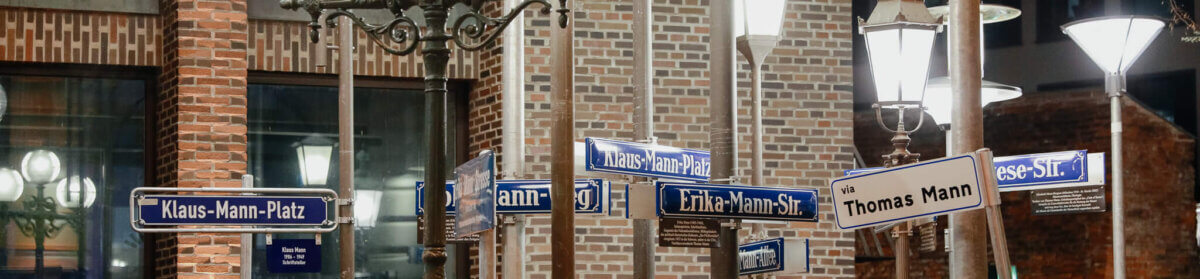
In June 2019, I was in Rome and Palestrina to explore streets named after Thomas Mann in light of the Mann memorial in Munich. Looking back, it was also interesting to see how natural it was to travel and move around in public space in contrast to the present day, 2020.
The road to Thomas Mann is quite long. The street named after him is on the outskirts of Rome. It takes one and a half hours on the 916 bus—including half an hour’s wait—all the other numbers pass by several times. When the bus finally arrives, it is full, with many commuters heading from the city center to the outskirts.
The street is in the northwestern district of Quartaccio on a ridge between flat valleys. The pejorative suffix “-accio” probably comes from the surrounding damp, marshy lowlands. Created in the 1980s as a hopeful and imaginative residential area—with postmodern references to the social housing of the 1920s and 1930s, gardens, arched passageways, and piazzas (used as parking lots)—it soon ran into problems, squatters, and drug dealing. Since the 2000s, the situation has improved with the construction of new apartment blocks and the influx of other demographic groups—but the area’s reputation still sticks, and it crops up often in police reports.
After disembarking, you walk over weathered concrete borders of dry green spaces. On Via Flaubert, you notice a group of concrete columns that form a square and are intended to evoke an archaeological park. Long rows of ochre-painted apartment blocks. People sitting on plastic chairs in front of their houses—reminiscent of Naples. At the edge of the house rows are fields, fallow land, reeds: the street becomes a dirt track, the city seems to be fraying; you can see down into a valley, in the distance there are more apartment blocks.
When I ask about Via Thomas Mann, two girls describe it as “In fondo, davanti alla chiesa” (at the end, in front of the church). There is indeed a street sign with this name under a tall streetlamp in front of a church dedicated to St. Faustina (think Doctor Faustus). It is quite modern with a wide overhanging metal roof on slender metal pillars. Only the cross on the roof and the hint of a temple-like roof identify it as a place of worship. It is connected to a sports center. The ASD Romana (sharks) basketball team trains here—an astonishing combination, but one that brings together two of the major social networks: church and sports.
Thomas Mann, however, was distanced from both. He was socialized as a Protestant but ironic in his approach to the religiosity of the church and its authorities (see the beginning of Buddenbrooks where Toni reads a chapter of the catechism). Astonishingly, he began Buddenbrooks in Italy (initially with his brother Heinrich) surrounded by Catholicism. The encounter is even more intense when you hear the church’s haunting Ave bells ring on every hour to the tune of the Lourdes melody. At 6:00 pm, a car pulls up in front of the church and nuns dressed in white get out. Time for mass. This is Rome. The contrasts could not be greater. The upper middle-class writer, here, in a—to put it mildly—structurally weak neighborhood. The “northern lights” of Lübeck and the cosmopolitan city to the south.
Yet, the coincidence goes beyond a street name that would only cover the canon of great European writers: Thomas Mann actually lived in Rome as a young man. Were the street name planners aware of this? Peter de Mendelssohn, who wrote the biography The Magician, mentions the addresses— Torre Argentina 34 and Via del Pantheon 57, 1897—in the chapter “Waiting in Rome.” Eight months after all! Mann himself also mentions his stay several times, including in his 1904 biography, but his former addresses are all in the heart of the old city, the centro storico, where tourists throng. In a place where everything is occupied by centuries-old buildings and names, it makes sense that the Romans did not name a street after the German writer there.
Here, on the periphery, however, there was space and the hope that the names might culturally enhance the construction project and give it a positive connotation as well as emphasize the unifying European culture. Thus, the great nineteenth-century writers from France and the northern countries are all concentrated here. The terminus is named after Andersen, there is a Via Fratelli Grimm, and Thomas Mann encounters, not inappropriately, Flaubert, Sand and Zola. He is thus associated with the 19th rather than the 20th century, a traditional context that he himself repeatedly emphasized.
It is noticeable that his “colleagues” are usually represented only by their last names. This makes sense in terms of the system of city maps, as it avoids the dilemma of whether to sort a street by a first name (as is generally the case in street directories) or a surname. Thomas Mann, however, is represented by both his first and last names. This demonstrates that there were more than just one writer named Mann, there were several, and that there is a need to designate individuals within the family by their first names. One certainly thinks of his brother Heinrich, who breaks with the restrictive use of the Mann name to only Thomas’ family.
Thomas was with Heinrich in Rome and for two summers in Palestrina, a small town about forty kilometers from Rome. There is a Via Thomas Mann there, too. And it is interesting to note that the brothers make a joint appearance there: Heinrich is also commemorated with a street name. That’s where we’re going next.
It takes about the same amount of time to get to Palestrina as it does to the Roman Quartaccio, only in the opposite direction to the east. It is an hour and a half by subway to the Anagnina stop, then by intercity bus through Rome’s countryside, which eventually merges into Campagna, with stops in small villages such as Zagarolo.
In Palestrina, Via Thomas Mann refers back to the Manns’ place of residence on this very street, making it the rare case where name and residence coincide. In 1895, Thomas and Heinrich lived in a boarding house here, in the summer freshness of the town, which is higher and cooler than Rome and from which you can look down onto the plain. The name of the street—at the top of a staircase-like alley that leads up steeply from the piazza next to the church—is a mosaic that alludes to those found in the excavations of ancient Preneste. In this way, Thomas Mann is drawn into the history and archaeology of the place just like the Roman finds in the Museo Archeologico next door. Cables and pipes next to and below the sign establish a connection to the present.
The stone plaque further up is in the style of memorial plaques found throughout Italy: large Roman capital letters carved in stone, traced in black. The inscription emphasizes the length of the stay, places it in historical context with a reference to the end of the 19th century, and interprets its purpose psychologically with a certain pathos: alla ricerca di se stessi (in search of oneself). There is also an interesting typographical detail: the space between “Thomas” and “Mann” is quite large. The intention was to ensure that the brothers’ first names, which appear on different lines, are more closely connected and clearly distinguishable from the family name—so that one does not read “Heinrich” and “Thomas Mann,” which would have made Thomas alone the representative of the Mann family.…
Around the corner there is an information board on a metal stand, a stop on the town’s archaeological trail. That’s how you find most of the information in Palestrina. The picture on it of Heinrich Mann has survived better than the one of Thomas.
Likewise, the brothers aren’t equally depicted in terms of street names either: a few steps up the Via Thomas Mann you come across an elevated travertine plaque for Largo Heinrich Mann. The term “Largo” is a bit exaggerated; it is a small park with terraces, benches, pine trees, and roses that is quite nice but literally falls a little short of Via Thomas Mann. This contrast also struck architectural and cultural historian Erik Wegerhoff in 2005, when he rode his Vespa through Palestrina during his contemporary reenactment of the Grand Tour and just as the homage to the Mann brothers was being completed. He notes ironically: “The Via Thomas Mann was freshly scrubbed, the Largo Heinrich Mann naturally a little grubby.”
The Via Thomas Mann takes a turn at the point where the Largo Heinrich Mann is located, further uphill, where another plaque shifts the balance of the Mann brothers’ names even further, in favor of Thomas. Perhaps this is due to the fact that Thomas Mann explicitly chose Palestrina as the place where Adrian Leverkühn, the protagonist in his novel Doctor Faustus, resides, thereby securing the town’s literary fame. Adrian’s encounter with the devil takes place behind one of these doors, in a vaulted hall that is cold even in summer, and in which he is promised musical genius and artistic creativity.
The Palestrinians have thanked him.