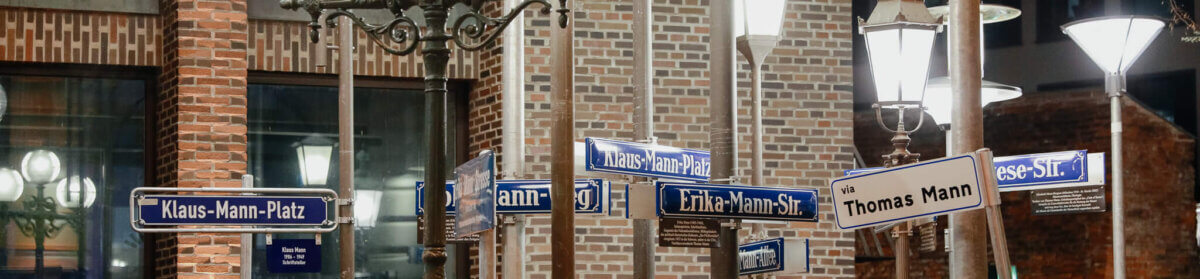
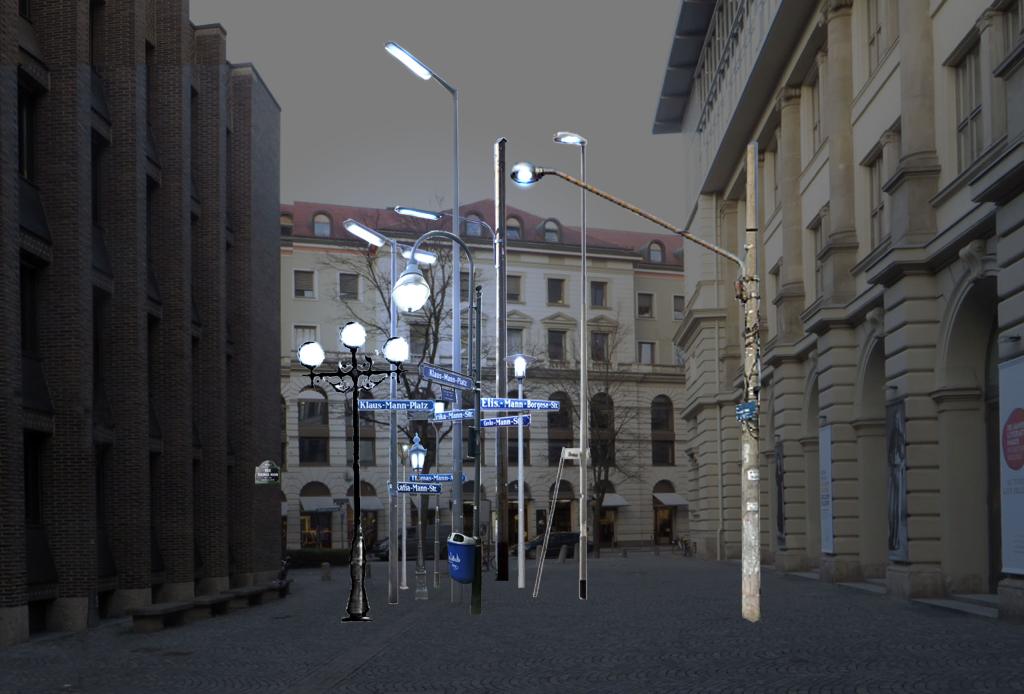
On 10.4.2019, the plenary assembly of the Munich City Council decided to realize the design of Albert Coers. Coers’ concept, which has won an invited art competition of the cultural department, bears the title „Straßen Namen Leuchten“ [Streets names lights].
Previously, on 28 March 2019, the City Council’s Culture Committee had unanimously decided to follow the jury’s proposal and award the contract for a „Memorial to the Mann Family“ at Salvatorplatz to the artist, who lives in Berlin and Munich .
The monument will be inaugurated on December 9, 2025, at 6 p.m. at Salvatorplatz in Munich.
The monument to the Mann family consists of an assembly of street signs named after members of the Mann family as well as streetlamps from those streets. The signs and lamps come from Munich, where Mann spent a majority of his life, but also from other cities and places related to the Mann family worldwide. The realization of the monument is planned for September-December 2025. Archaeological finds at Salvatorplatz in 2024 made it necessary to redesign the foundations of the lights.
The internationality of the family is reflected in the signs and lights – beginning in Munich and radiating out to other cities in Europe, the USA, and South America – as well as the family’s worldwide literary presence and significance. This is also evident from the different street names (Via, Rue, Rua). The arrangement is based on the topographical position of the individual cities in relation to one another and forms an imaginary map. The monument addresses the commitment to a specific place but also aspects of emigration, mobility and frequent change of place as well as transnational cosmopolitanism, for which the family can be regarded as a forerunner and example.
The point of departure is Munich, the center of the family’s life for many years, where there are several streets and squares named after members of the family: Thomas Mann but also Erika, Klaus, Elisabeth and Golo. Some of these streets are located in less-frequented neighborhoods, new housing estates or on the periphery and thus have little presence in the collective memory. These street signs, together with the streetlamps to which they are attached, are brought to the center of the city and assembled as a group at the Salvatorplatz (Salvator Square), where they are more visible and come into contact with one another in a kind of “family reunion.” At the same time, they refer back to their original locations so that the monument as a whole emphasizes its connection to urban structures.
Names
A new sign will be created for Katia Mann, for whom
no street has yet been named. This will make “Mrs. Thomas Mann” more visible in
relation to the city in which she was born and whose family – the Jewish Pringsheim family – like the Manns,
lost their property and had to emigrate. Giving her a street name in the
monument anticipates what would otherwise be a lengthy process. This mixture of
reality and fiction references literary procedures practiced by Thomas and
Klaus Mann.
Lights
Circa fifteen street signs and streetlights are planned. In addition to those from Munich, others will demonstrate the span between Europe and North and South America and will establish connections. One street sign comes from Paris. Another from the city of Lübeck, the birthplace of Thomas Mann as well as the setting for Buddenbrooks. A streetlamp and sign from Klaus-Mann-Platz in Frankfurt (the location of a monument to persecuted homosexuals) serves as a reference to an aspect of the identity of several family members. Rome is present as the residence of Thomas (and Heinrich) Mann at a young age. The South American link (Thomas Mann’s mother Julia came from Brazil) is represented by a streetlamp and sign from São Paulo. One lamp will come from Nida, Lithuania, the preferred summer retreat of the Mann family. A lamp from Sanary-Sur-Mer on the Côte d’Azur, the first place the family emigrated to in the 1930s, represents the family as a whole. Two streetlamps come from the United States: one from New York, near the former Hotel Bedford, where members of the Mann family stayed, most frequently Erika and Klaus. Another from San Remo Drive in Los Angeles refers to the villa Thomas Mann built there in 1942, in which he lived until his return to Europe. A streetlamp from Kilchberg near Zurich establishes a link to the residence of Thomas and Katia as well as Erika (for whom a street in Zurich is named) and finally Golo.
Research trips to the respective locations are part
of the project, as is a book publication that documents, conveys and
supplements the background and development of the monument, including the
current situations of the street signs and streetlights on site.